About the Book
The Last Hand: Still Here
Book One of The Last Hand: a dystopian thriller about two brothers raised on opposite sides of a wall they didn’t know was there.
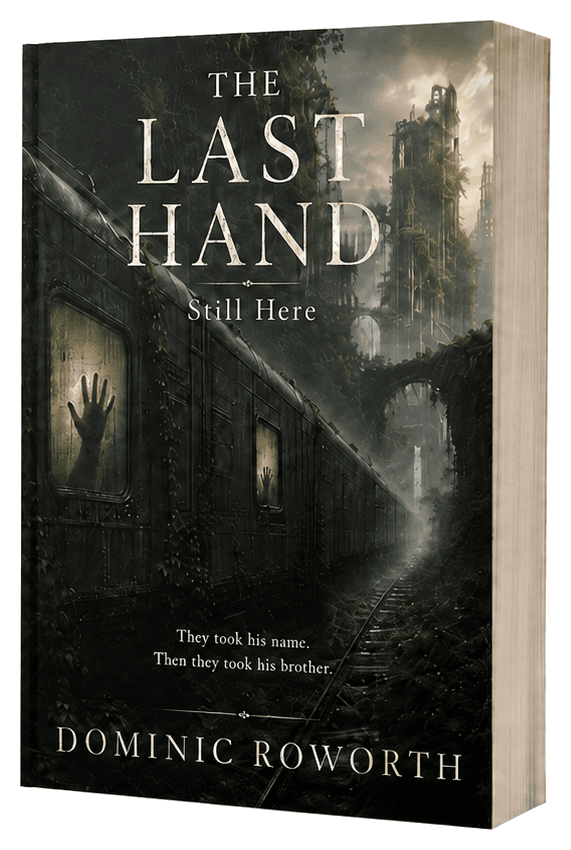
The Pitch
Two hundred years after a collapse that wasn’t an accident, the world is ruled by the Last Hand, a quiet cabal of administrators who engineered the end of the old world to build a new one in their own image. They are still alive. They are still in charge. And every year they harvest the male children of the wild, boys of fourteen, and march them through a system designed to break the ones who can’t be used.
Elias Vance is fourteen the morning the grey-ones come to his village. He has a younger brother, Cassian. They are taken on the same train.
At a junction halfway to the camps, on the order of a man whose name nobody outside the inner circle knows, the brothers are separated. The younger is sent to the leader’s house. The older is sent to the Pit.
Elias does not see Cassian again for four years.
What he does in those four years, what he becomes, what he survives, what he loses, what he is willing to do to climb back toward the only person in the world he still has, is the story of Still Here.
What it is
A 576-page debut dystopian thriller. First person. Past-tense retrospective with present-tense vivid passages. Brutal but hopeful. Literary but propulsive.
The Hand is not a tyranny of jackboots and parades. It is administrative. It is patient. It runs spreadsheets. It has been running them for two hundred years.
The resistance is not a guerrilla army. It is a city of nine thousand under the ground, mostly women, with one knife and the patience of a generation.
The protagonist is not a chosen one. He is the older brother of the chosen one. And his climb to the top of a year-long competition called the Trials is not, in the end, a climb toward power. It is a climb toward a door he has been told will, if he survives it, open onto a room with his brother in it.
It does.
That is where the book ends.
What you’ll find inside
- A boy taken from a village, given a number, and put in a hole called the Quiet on his third day for testing.
- A friend named Pip who teaches the rules of survival and dies with a secret he stole from a manifest in a tent.
- A year-long competition across a country called the dead lands, in which five thousand teenagers hunt each other for the right to join the leader's elite.
- A girl in a medic block with green eyes who keeps the protagonist's name on a list she does not let him see.
- A cliff. A fall. A river.
- A hidden city under the ground, built for a war that has not yet been declared.
- A mother who walked out of the design facility one night with a piece of physical evidence she had built in plain sight of the men assigned to monitor her, and who died in their custody one hundred and forty-one days later having told them nothing.
- A letter from that mother, written sixteen years before her son could read it, held by a man with pale eyes who loved her in a way that did not need a word.
- A meeting in a corridor that lasts three and a half seconds.
- A fight on a lawn at dawn.
Voice
The book is told in first person by Elias, looking back from some point in the future on the year and the camps and the Hollow and the lawn at dawn. The retrospective frame allows him to tell you, in the same sentence, what he believed at fourteen and what he understands at nineteen. It is the voice of a young man who has been broken and who has learned a slower, harder way of speaking about the breaking.
The sentences are long when the world is patient and short when it is not.
There is a recurring two-word prayer: Still here. Still here. It is the title.
It is also the only thing the protagonist has, by the end, that the Hand has not been able to take from him.
Themes
- Brothers separated by a system that wanted them separated.
- The cost of mercy. What it takes to spare someone. What it costs not to.
- What survives training. Where the foundation a mother built before you were two ends and the man other men build on top of you begins.
- The administrative banality of evil. Spreadsheets. Sortings. Categories at fourteen. Nothing dramatic. Just the patient management of human stock.
- The body remembers. A sound made against a cot wall at two. A palm pressed against the other side. A receiver that lights up only for one bloodline.
Series shape
The Last Hand is planned as a trilogy.
- Book One, Still Here. The camp, the Trials, the cost. Ends on a fight on a lawn at dawn.
- Book Two. The wider world. The Hollow’s war. The sorted order revealed. The work begins.
- Book Three. The truth of the Last Hand. The proof. The reckoning.
Each book is designed to stand alone. The series engine is what their mother died with: the evidence she hid in a place only she knew, retrievable only by her sons, between them.
A note from the author

The Count of Monte Cristo is my favourite book.
I read it for the first time as a teenager and I have not stopped thinking about it since. The slow patient forging of a man in the dark, the years it takes him to become the thing he eventually walks back into the world as, the quiet cost of every door he closes on his way, that book gave me a vocabulary for a kind of story I had been wanting to tell for a long time without knowing I was wanting to. I wrote Still Here in part because I wanted to live, for many months, inside the kind of patience that book taught me.
I wrote it over many months. Mornings, evenings, the small specific hours when the house was quiet and the work could happen. It is my first novel. It is the first part of a three-book series. The second and third books are coming. I am already writing them.
I think a lot about what a book is for. I think a book is for a reader to sit with a thing the writer was sitting with, and to find the parts of themselves the writer also found while sitting with it. I have, in the months I have been sitting with this one, found things I did not know I was looking for. I hope, when you read it, you find some of yours.
The book is brutal in places. I have not, in any of those places, asked the reader to look at something for its own sake. The brutality is the cost of the thing the book is about. If you let it land where it lands, the hope at the end is real and earned and it is the part I am most proud of.
If any of it sticks with you, find me. Tell me what stuck. Tell me where I got it wrong and where I got it right. I am at the start of a writing life and the people who tell me what they thought are the people who will shape what comes next.
Thank you for reading.
Dominic
Where to read
Out now on Amazon.
Still Here is available now in Kindle and paperback. You can read the first chapter free first, then take the rest with you.
Get notified when Book Two lands
Books Two and Three are already being written. Join the list and you will be first to know when the next one is ready.
If you read it and enjoy it, please leave a review and share it with someone who would. The book travels best by word of mouth.